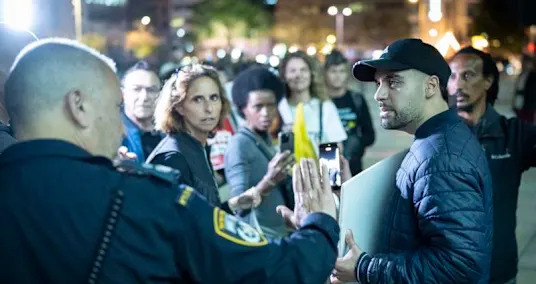
Protests took place in Tel Aviv, Jerusalem, Haifa, and Beersheba, as a survey found broad but uneven support among Jewish Israelis for Operation Roaring Lion.
Israel Police arrested 21 anti-war protesters Saturday night as demonstrations against the conflict with Iran expanded in multiple cities despite restrictions on public gatherings.
Protests took place in Tel Aviv, Jerusalem, Haifa, and Beersheba, with hundreds of participants reported in Tel Aviv and Jerusalem and about 100 in Haifa, marking the largest turnout since weekly demonstrations began. Authorities said 13 people were arrested in Tel Aviv and eight in Haifa.
Police said the gatherings were not approved under Home Front Command regulations that ban events with more than 50 people. Officials said the increase in turnout followed calls by groups opposing the government to protest despite the restrictions.
“During a situation assessment that took place at the scene with a Home Front Command representative… it was clarified that there was a real risk to human life and accordingly, Yarkon [precinct] police commander Tzachi Sharabi ordered the gathering to be dispersed,” police said.
Hadash-Ta’al chairman Ayman Odeh, an Arab lawmaker involved in the protests, criticized the police response, calling officers fascists “in the service of the government” and saying they were afraid of “the heroic citizens who went out, despite everything, to make their voice heard.”

Survey shows broad, uneven support for war
The demonstrations come as a March 2026 survey by the Israel Democracy Institute found broad but uneven support among Jewish Israelis for Operation Roaring Lion. Support was strongest on the Right at 87% and about half on the Left.
The survey also found that Jewish and Arab respondents largely agreed that Iran’s resilience has been stronger than expected. Most Jewish respondents said Israeli society could sustain the campaign for up to one month, while 28% said as long as needed. Arab respondents were less optimistic about how long the public could endure the conflict.
A majority of Jewish respondents said Prime Minister Benjamin Netanyahu’s decision was driven by security considerations, while most Arab respondents viewed it as political.
LATEST POSTS
- 1
 Extravagance SUVs for Seniors: Solace, Innovation, and Security
 - 2Day to day Temporary Positions That Compensate Fairly in the US
- 3EU Commission prepares €90bn Ukraine loan despite Hungary's veto
- 4Study casts doubt on potential for life on Jupiter's moon Europa
- 5A red meat allergy from tick bites is spreading – and the lone star tick isn’t the only alpha-gal carrier to worry about




- The Reduced Portage Horse: An Inheritance Reconsidered for Present day Experience
- Tributes pour in for James Ransone, 'The Wire' actor who died at 46
- Taco Bell debuts its Baja Blast pie, and the reactions may surprise you
- Nurturing Hacks: Astuteness from Experienced Mothers and Fathers
- This professional Santa's dream of spreading holiday cheer fuels stroke recovery
- Rick Steves' Newest Guidebook Is A Fresh Perspective On Italy Spilling The Country's Secrets
- A Manual for Extravagant Vehicles Available in 2024
- From Modesty to Administration: Self-improvement in Interactive abilities
- Consumer experts: German petrol hikes rule won't bring down prices