The post Hidden Island Cameras Capture Rare Tasmanian Species for the First Time Ever appeared first on A-Z Animals.
Quick Take
Motion-sensor cameras were set up at seven locations across Truwana/Cape Barren Island, off the northeast coast of Tasmania.
They were in place from November 2024 to May 2025 and captured about 500,000 images.
The cameras captured images of white-footed dunnarts, blonde echidnas, and Latham’s snipes.
On Truwana/Cape Barren Island off the northeast coast of Tasmania, several rarely seen animals were captured on camera for the first time. The images were taken as part of a camera survey led by indigenous Truwana Rangers, and supported by WWF-Australia’s Eyes on Country Program and Dr. Elizabeth Znidersic from Charles Sturt University. White-footed dunnarts, blonde echidnas, and Latham’s snipes were all photographed on the second-largest island in the Furneaux Group chain.
Rangers set up 30 motion-sensor cameras at seven sites on the island. The cameras were in place from November 2024 to May 2025. During that time, half a million images were captured on the cameras’ SD cards. As the research team began sorting through all the pictures, they were surprised by what they found – especially since the island has a large population of non-native, feral cats. The researchers quickly discovered that despite the constant presence of these predators, small mammals were able to not just survive, but thrive in large enough numbers to be repeatedly caught on camera.
What Did Researchers Find?
The cameras photographed a number of species that surprised and delighted researchers. White-footed dunnarts, tiny carnivorous marsupials, were present on the island. Dunnarts are rarely seen on any of the Furneaux Group islands. Researchers believe there may be fewer than 5,000 in neighboring Tasmania, and the species is listed as vulnerable in nearby New South Wales.

Dunnarts, like this striped-face dunnart, are native to Australia, Tasmania, and nearby islands.
©Chris Watson/Shutterstock.com
But on Truwana/Cape Barren Island, dunnarts were captured on camera at six of the seven locations. Researchers point to several factors that are helping the species to thrive on Truwana.
One of the biggest factors is that the island was returned to Aboriginal ownership in 2005. Since that time, the local population, which numbers less than 100 people, has gone on a mission to care for and maintain their island home. The Truwana Rangers are a big part of that effort. They conduct regular weed control along with cultural burning to restore natural landscapes.
They also work hard to keep the island’s feral cat population under control. Almost daily, rangers head out armed with cans of sardines and cages to trap the feral cats. The program has been a success, with around 30 feral cats captured each winter.
Unlike other nearby islands, Truwana/Cape Barren Island was spared from the colonial-era land clearing that made way for pastures and fields to grow crops. The natural vegetative cover found across the island can be used by small rodents to evade predators. Rangers are taking care to keep that natural ground cover healthy and thriving.
Besides the white-footed dunnarts, another rare camera capture was of two blonde echidnas (spiny anteaters) who were photographed along with darker echidnas. The pale echidnas are not true albinos, but instead have a genetic mutation that causes leucism – a reduction in pigment that gives them their pale color. Blonde echidnas are very rarely spotted anywhere. Seeing them on Truwana/Cape Barren Island was an exciting find for researchers.

Blonde echidnas were also captured on camera during the study.
©Kirsty Hulme/Shutterstock.com
Other rarely seen species caught on camera during the study include the Tasmanian subspecies of long-nosed potoroo and the eastern pygmy-possum. Potoroos are small, nocturnal marsupials, sometimes referred to as rat kangaroos. The eastern pygmy-possum is one of the smallest possum species in the world, weighing less than a golf ball.
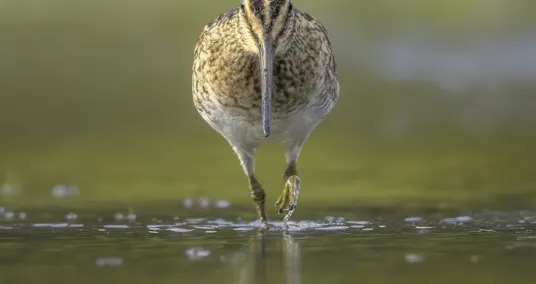
However, one camera sighting was special for another reason. Photographs of Latham’s snipe gave researchers confidence about the island’s ecological health. This shy, secretive bird, classified as vulnerable in some Australian states and territories, breeds in northern Japan and the islands of far-eastern Russia, then migrates to Australia.

The Latham’s snipe migrates from Japan and eastern Russian islands to Australia each season.
©Wirestock Creators/Shutterstock.com
The birds’ presence on Truwana/Cape Barren Island tells researchers the island’s wetlands are in good condition and provide a critical habitat for the birds to rest during their long migration cycle. Until this study, Latham’s snipe had never been photographed on Truwana/Cape Barren Island.
How This Data Will Help Conservation Efforts
The Truwana/Cape Barren Island camera project succeeded not only because of collaboration among conservation organizations, but also due to the deep involvement of the local population, particularly the Truwana Rangers. Direct involvement of the Indigenous population, who live and work on the island, provides a level of commitment and attention rarely found in similar studies.
On a larger scale, the findings show that proactive native vegetation management is essential to support a diverse population of species, especially where non-native predators have been introduced. The study offers proof that long-term land management and non-native species control, managed and led by local populations, works. Researchers believe the framework in place on Truwana/Cape Barren Island can be replicated in other places to support biodiversity.
The post Hidden Island Cameras Capture Rare Tasmanian Species for the First Time Ever appeared first on A-Z Animals.
LATEST POSTS
- 1
 It's your last chance to subscribe to Paramount+ before they raise their prices: Here's how to lock in current pricing
 - 2Vote In favor of Your #1 Compelling Female Producer
- 3The 10 Most Noteworthy Games in History
- 4At least 490 protesters killed in Iran, activists say
- 5German hauliers warn soaring energy prices may soon impact consumers



- The most effective method to Quick Track Your Outcome in Advanced Showcasing with a Web-based Degree
- Alleged maple syrup scam in Quebec uncovered by Canadian broadcaster
- Hundreds show fascist salute at rally in Rome in annual ritual
- Space debris: will it take a catastrophe for nations to take the issue seriously?
- Understanding Preschool Projects: Cultivating Abilities and Advancement
- U.S. overhauls childhood vaccine schedule, recommends fewer shots
- Etymological Investigation Disclosed: A Survey of \Dominating New Tongues\ Language Learning Application
- Good ways to respond if your kid brings home less-than-ideal grades
- 5 Movies That Leaving an Imprint with Inventive Innovation