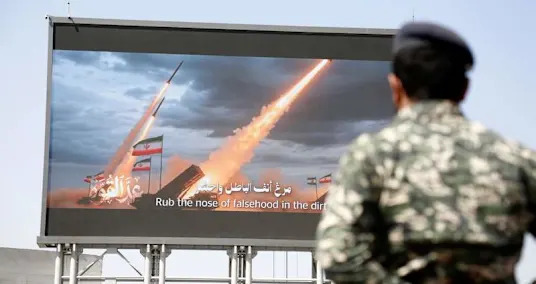
Part of the question for Israel is how many of the missiles, many of which have been covered in rubble, can be salvaged and are only temporarily inaccessible to Iran?
Although the majority of the IDF believes that Iran only has several hundred ballistic missiles left, which can reach Israel from its original 2,500 total, IDF sources have admitted to The Jerusalem Post that no one really knows for certain.
The exchange came after Channel 12 reported on Saturday night from air force IDF Col. "T" that the Islamic Republic still has more than 1,000 ballistic missiles left, directly contradicting the prior IDF estimate of several hundred missiles.
In the exchange between the Post and the IDF, the military first backed the prior estimates that Iran had several hundred missiles left, but then added that no one really knows for sure.
How many missiles are salvageable after Israeli strikes?
Part of the open question is how many of the missiles, which have been covered in rubble, can be salvaged and are only temporarily inaccessible to Iran?
Within that question, there is a subcategory between more mild rubble cave-ins and larger cave-ins.

In some cases, Iran has developed bulldozer teams and techniques to uncover caved-in missile teams or silos within less than a day, according to foreign sources.
For such situations, the ballistic missiles might not only still be part of Iran's long-term arsenal, but might be usable even in the short-term.
Missile launchers are an entirely additional part of the picture.
At multiple points, the IDF has hedged on how many Iranian ballistic missile launchers have been destroyed and how many have been buried and neutralized, with the average being around 50% destroyed and 50% buried out of around 70-80% which have been put out of commission at least for some period of time.
Confusingly, at times the US and the IDF have said that Iran's missile capabilities were reduced by 90%, but then at other times Iran's missile rate has sometimes temporarily risen again.
Iran's firing rate declining over course of war
Generally, Iran's missile rate fell below 20 missiles per day by day four of the war, and in recent weeks fell even lower.
All of these questions leave many open issues which defy easy categorization and attempts to arrive at a set number of what Iran has left on the missile front.
Despite these questions, there are some relatively set numbers that help frame the issue.
For example, Israel knows that Iran has fired over 500 missiles at it.
The Gulf states have publicized that Iran has fired around 1,300 missiles at them collectively.
The IDF has repeated that Iran had around 2,500 missiles at the start of the war, which would leave them with fewer than 700 missiles even if the IDF had not destroyed any.
Presuming the IDF has destroyed at least a few hundred, then Iran would have only a few hundred missiles left.
There is still the possibility that the IDF underestimated the total number of missiles that Iran possessed at the start of this war.
This has occurred before with the IDF having said in June 2025 that Iran had 2,500 missiles, and revising that number months later to 3,000 missiles.
LATEST POSTS
- 1
 Nick Reiner's defense attorney asks to be replaced, again delaying arraignment in connection with the stabbing deaths of his parents, Rob Reiner and Michele Singer Reiner
 - 2Katz alleges Army Radio workers misled High Court in bid to halt closure
- 3First foreign troop in new gang suppression force lands in Haiti to replace previous mission
- 4The Tiny Channel Island With 65 Residents That Chefs And Foodies Go Out Of Their Way To Visit
- 510 Distinct Kinds of Chinese Neighborhood Specialty Hot Pot





- In the background: Visiting Notable Film Areas All over the Planet
- Scaling New Levels: Rock Climbing Spots On the planet
- The next frontier in space is closer than you think – welcome to the world of very low Earth orbit satellites
- Midlife weight gain can start long before menopause – but you can take steps early on to help your body weather the hormonal shift
- It's your last chance to subscribe to Paramount+ before they raise their prices: Here's how to lock in current pricing
- Instructions to Discuss Successfully with Your Auto Collision Lawyer
- Best Augmented Simulation Ride: Which One Feels Generally Genuine?
- Winter storms blanket the East, while the U.S. West is wondering: Where’s the snow?
- Israel says it killed armed Hamas 'terrorists' in Gaza