When you buy through links on our articles, Future and its syndication partners may earn a commission.

Astronomers have observed a strange but powerful supernova explosion that not only marked the death of a massive, highly evolved star, but also may have heralded the birth of a pair of binary black holes.
The team behind this discovery studied the supernova explosion SN 2022esa with the 8.2-meter Subaru telescope located at the Mauna Kea Observatory in Hawaii and the Seimei telescope in Japan.
They found the supernova was likely the result of the explosive death of a massive, hot, luminous star at the end of its evolutionary development, known as a "Wolf-Rayet star." This star dwelled in the galaxy 2MFGC 13525, located around 320 million light-years away from Earth.
The scientists discovered that SN the supernova demonstrated a clear and stable period lasting around a month, which led them to theorize that it was the result of periodic eruptions in this system, one each Earth-year before the final explosion.
That kind of stable periodicity is only possible in a binary system, the researchers say, indicating this doomed Wolf-Rayet star was partnered by either a black hole or a massive star that will one day explode to birth a black hole. The end result in both cases is a black hole binary.
"The fates of massive stars, the birth of a black hole, or even a black hole binary, are very important questions in astronomy," team leader Keiichi Maeda of Kyoto University said in a statement. "Our study provides a new direction to understand the whole evolutionary history of massive stars toward the formation of black hole binaries."
The team's findings don't just reveal more about binary black holes and their origins; they also demonstrate the power of teaming two different telescopes with different capabilities. The Seimei telescope brings flexibility and rapid response times to this tag-team, while Subaru provides its high-sensitivity.
As a result, these telescopes are likely to remain teamed for years to come.
"We expect many interesting discoveries on the nature of astronomical transients and explosions like supernova," Maeda said.
The team's research was published in November in Physical Review Letters.
LATEST POSTS
- 1
 Social Skylines d: A Survey of \Inside and out Social Experiences\ Language Learning Book
 - 2Exploiting Unsold Rams: May Be Less expensive Than You Suspect
- 3Did we start the fire? A 400,000-year-old hearth sparks new questions about human evolution
- 4Czech Republic caps fuel prices amid Iran war energy crisis
- 5The Drone Video of the Year is stunning – you've not seen Namibia like this




- What you need to know about desalination, a growing source of drinking water
- Remain Fit: Powerful Wellness and Work-out Schedules for a Better You
- The Response to Fake General Knowledge: Investigating the Eventual fate of artificial intelligence
- A definitive Manual for the 5 Off-road Bicycles Available
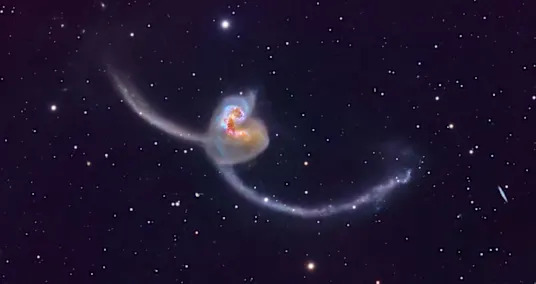
- Astrophotographer captures spectacular photo of Antennae Galaxies dueling in deep space
- New Year's superstitions: Eating 12 grapes, avoiding laundry and other rituals that are said to bring good fortune
- Washington resident is infected with a different type of bird flu
- Flourishing in a Remote Workplace: Individual Techniques
- Step by step instructions to Guarantee Your Internet Promoting Degree Supplements Your Profession Objectives